


Most people walk into a casino — or open one on their phone — and assume that understanding the numbers on the screen requires some kind of finance degree. It doesn’t. Reading casino odds is one of those skills that sounds intimidating until someone breaks it down for you the right way, and once it clicks, you’ll never look at a game the same way again. This guide exists for exactly that reason: to give you real, working knowledge of how casino odds function, what they mean for your wallet, and how to use them to make smarter decisions every single time you play.
What Casino Odds Actually Mean
At the most basic level, casino odds tell you two things simultaneously: how likely an event is to happen, and how much money you stand to win if it does. These two pieces of information are always connected, and the relationship between them is where the casino’s business model lives. When you see odds of 35 to 1 on a straight-up roulette bet, the game is promising to pay you 35 dollars for every dollar you wager if your number hits. What it isn’t telling you outright is that the true probability of hitting that number on a standard European roulette wheel is 1 in 37 — not 1 in 36. That one extra slot is the house edge, and it’s quietly built into almost every game you’ll ever play.
Understanding this gap between what the odds pay and what the odds truly are is the single most important concept in all of gambling literacy. You don’t need algebra to grasp it. You just need to know that casinos are businesses, they price their products to be profitable, and those prices are baked into the payout structure of every single bet on the floor.
The Three Formats You’ll Encounter
Casino odds appear in three main formats depending on where you’re playing and what type of game you’re sitting at. Fractional odds, which look like 5/1 or 10/3, are most common in UK-based platforms and horse racing contexts. The top number tells you how much you win, and the bottom number tells you how much you need to stake. So 5/1 means a five-dollar profit for every one dollar wagered. Decimal odds, written as 6.00 or 2.50, are dominant across European casinos and most online platforms. To calculate your total return, you simply multiply your stake by the decimal number shown. A $10 bet at 6.00 returns $60 total, meaning $50 profit plus your original $10 back. American odds, also called moneyline odds, use a plus or minus sign followed by a number. A +200 line means a $100 bet wins $200, while a -150 line means you need to wager $150 to win $100. Once you know which format you’re looking at, the mental math involved is genuinely straightforward.
House Edge by Game: Where Your Money Is Safer
Not all casino games are created equal, and the differences between them are significant enough to change how you approach your bankroll. The table below shows the approximate house edge for the most popular casino games, which represents the percentage of each bet the casino expects to keep over a large number of rounds.
| Game | Variant / Bet Type | Approximate House Edge |
|---|---|---|
| Blackjack | Basic strategy play | 0.5% – 1% |
| Baccarat | Banker bet | 1.06% |
| Baccarat | Player bet | 1.24% |
| European Roulette | Any single number | 2.7% |
| American Roulette | Any single number | 5.26% |
| Craps | Pass Line bet | 1.41% |
| Video Poker | Jacks or Better (9/6) | 0.46% |
| Slots | Standard machine | 2% – 15% |
| Keno | Typical game | 20% – 35% |
The practical takeaway from this table is enormous. Choosing blackjack with basic strategy over a standard slot machine doesn’t just feel different — it mathematically changes the outcome of your session. A $500 bankroll playing blackjack correctly is exposed to roughly $2.50 to $5 in expected loss per hundred hands, while the same money on slots could theoretically evaporate far faster depending on the machine’s configuration.
Return to Player: The Slot Machine Translation
Slots speak their own language when it comes to odds, and that language is called Return to Player, or RTP. You’ll see this expressed as a percentage, typically somewhere between 88% and 98% on modern machines. A 96% RTP slot means that, over millions of spins, the machine is designed to return $96 for every $100 wagered. The remaining $4 is the house’s cut. What RTP does not tell you is anything about variance, which is how wildly the results swing in any individual session. A high-volatility slot with 96% RTP can still drain your credits rapidly in the short term because the wins are clustered into rare but large payouts rather than frequent small ones. When you’re comparing slot games, always look for both RTP and volatility rating together — neither number alone tells the full story.
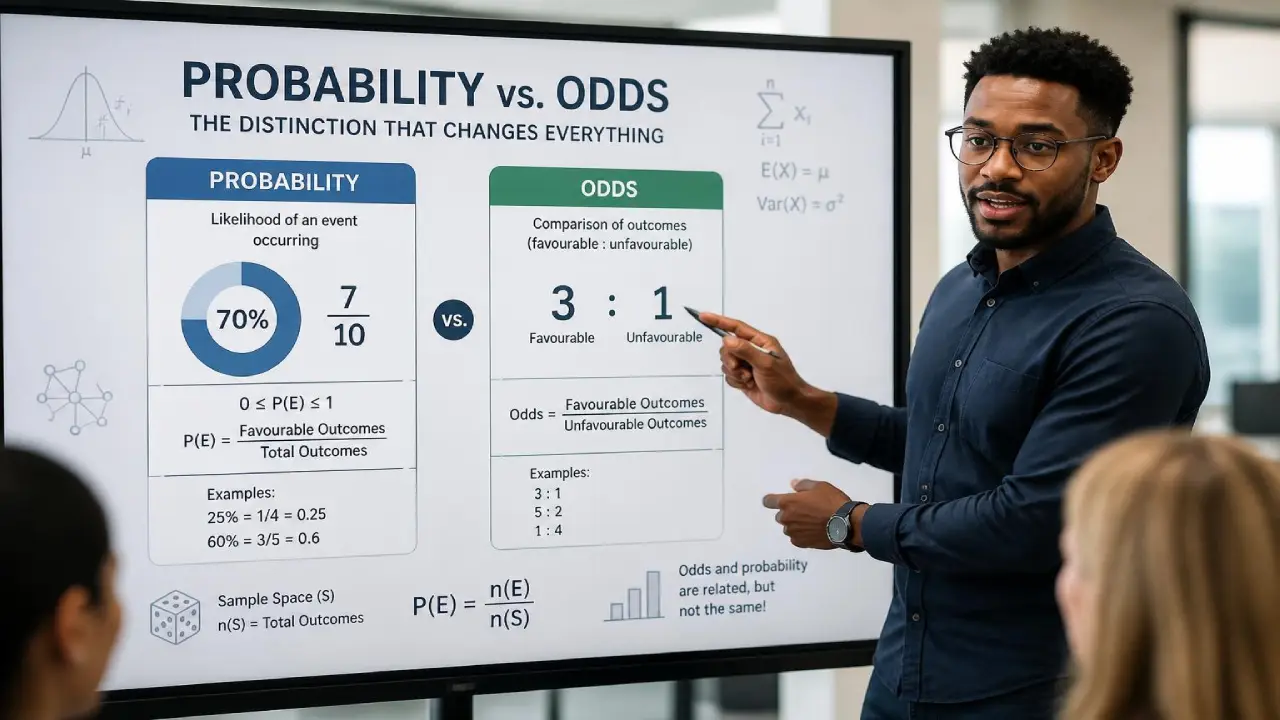
Probability vs. Odds: The Distinction That Changes Everything
One of the most common points of confusion is treating probability and odds as if they’re interchangeable. They’re not. Probability expresses likelihood as a fraction or percentage of all possible outcomes. The probability of rolling a six on a fair die is 1 in 6, or approximately 16.7%. Odds, on the other hand, express the ratio of favorable outcomes to unfavorable ones. The odds of rolling a six are 1 to 5, meaning one success for every five failures. Casinos use both frameworks, and understanding which one is being used in a given context helps you evaluate whether a payout is fair or quietly tilted against you. When a casino advertises “odds of 5 to 1,” they’re describing a ratio. When they say “you have a 16% chance,” they’re describing a probability. Both describe the same underlying event, but they carry different psychological weight, and marketers know this.
The Gambler’s Fallacy: Why Past Results Mean Nothing
No discussion of casino odds would be complete without addressing the most expensive misconception in gambling culture. The gambler’s fallacy is the deeply intuitive but mathematically false belief that past results influence future outcomes in games of independent chance. If red has come up ten times in a row on a roulette wheel, the probability of red on the next spin is still exactly what it always was — approximately 48.6% on a European wheel, slightly less on American. The wheel has no memory. Each spin is statistically isolated from every spin that came before it. This matters enormously because many casino betting systems — including the famous Martingale strategy — are built on the assumption that losing streaks will correct themselves, which leads players to increase their stakes at exactly the wrong moments. Knowing that casino odds don’t have a correction mechanism built in is the kind of knowledge that protects your bankroll over the long run.
How to Use Odds to Choose Your Bets Wisely
Once you understand the basic framework, making smarter bet selections becomes a matter of comparison rather than calculation. In roulette, betting on red or black (house edge of 2.7% in European rules) is mathematically far more sustainable than betting on a straight number (same house edge but extreme variance). In craps, placing a Pass Line bet and then adding full odds behind it reduces the overall house edge on your combined stake to near zero, making it one of the best bets on the entire casino floor. In blackjack, surrendering a hard 16 against a dealer’s 10 isn’t a sign of weakness — it’s the mathematically optimal move that loses less money over time than hitting or standing. These aren’t advanced tactics. They’re simply what happens when you respect the numbers instead of ignoring them.
Finding Your Edge as a Recreational Player
You will never eliminate the house edge. Any system, strategy, or tipster claiming otherwise is either selling something or confused about how mathematics works. What you can do is narrow it to the point where your entertainment budget stretches further, your sessions last longer, and your swings are predictable enough that gambling stays fun rather than becoming stressful. Play games with a house edge below 2% whenever possible. Set a session bankroll that you’re genuinely comfortable losing completely, then treat anything that remains at the end as a bonus rather than an expectation. Learn the basic strategy chart for blackjack — it takes roughly an hour and cuts the house edge roughly in half compared to intuitive play. Choose European roulette over American when both are available, because that 2.7% versus 5.26% gap is substantial over dozens of bets.
Leave a Reply