


Starting your online casino journey does not require a thick wallet or a high-roller mentality. Some of the most enjoyable and rewarding experiences in the entire casino world are accessible to players working with modest budgets of ₹500, ₹1,000, or even less per session. The secret is not finding a magical game that guarantees wins. It is choosing the right games, the right bet sizes, and the right strategies that stretch your money as far as possible while giving you genuine entertainment and a real chance at walking away with more than you started with.
The mistake most beginners make is gravitating toward the flashiest, loudest, most heavily promoted games without considering whether those games are actually compatible with a small bankroll. A high-volatility slot with a ₹50 minimum bet might look exciting in the lobby, but it will consume a ₹1,000 budget in 20 spins and leave you watching from the sidelines before you have even figured out how the bonus feature works. A progressive jackpot game with a 7% house edge might promise life-changing payouts, but the mathematical cost of chasing that dream is far higher per rupee wagered than games that offer better odds and longer sessions.
This guide identifies the specific casino games that offer the best combination of low minimum bets, favourable mathematics, beginner-friendly mechanics, and extended playing time for players who want to make every rupee count. Each recommendation is grounded in mathematics, not marketing, and is designed to help you build skills, enjoy the experience, and develop healthy gambling habits from the very first session.
What Makes a Game Good for Small-Budget Beginners
Before looking at specific games, it helps to understand the four criteria that determine whether a game is genuinely suitable for a beginner playing with limited funds. Not every low-minimum-bet game is a good choice, and not every popular game works well on a small budget.
The first criterion is house edge. Games with lower house edges cost you less per unit wagered over time, which means your bankroll lasts longer and your expected entertainment value per rupee is higher. A game with a 1% house edge costs you roughly ₹10 per ₹1,000 wagered, while a game with a 10% house edge costs you ₹100 for the same wagering volume. On a small budget, this difference is not a minor detail. It is the difference between a 90-minute session and a 15-minute session.
The second criterion is volatility. Low to medium volatility games distribute their returns in frequent, smaller payments that keep your bankroll alive and your session going. High-volatility games concentrate their returns in rare large payouts, which means you can easily burn through a small bankroll during the long dry stretches between hits. For a beginner with a limited budget, consistent positive feedback is more important than the theoretical possibility of a massive win you may never see.
The third criterion is minimum bet size. A game might have excellent mathematics, but if its minimum bet is ₹100 per round, a ₹1,000 bankroll gives you only 10 rounds before you are done. Games with low minimums, ideally ₹1 to ₹20 per round, provide enough volume to experience the game properly, learn the mechanics, and give variance a chance to work in your favour.
The fourth criterion is complexity. Beginners benefit from games with simple, intuitive rules that can be learned in minutes rather than hours. Complex strategy games like poker or multi-bet craps can be excellent value for experienced players, but the learning curve costs money when you are making suboptimal decisions while figuring out how the game works.
| Selection Criterion | What It Means for Small Budgets | Ideal Range for Beginners |
|---|---|---|
| House edge | Lower edge means slower bankroll erosion | Below 3% ideally, under 5% acceptable |
| Volatility | Lower volatility means more consistent returns | Low to medium for budget play |
| Minimum bet size | Lower minimums mean more rounds per session | ₹1 to ₹20 per round |
| Game complexity | Simpler rules mean fewer costly mistakes | Learnable in under 5 minutes |
| RTP | Higher RTP returns more money over time | 96% or above for slots, 98%+ for table games |
| Session length potential | More rounds per budget means more entertainment | 100+ rounds per ₹1,000 minimum |
Blackjack: The Best Mathematical Value in the Casino
If you could only play one casino game for the rest of your life and wanted the best possible odds, blackjack with basic strategy would be the correct choice. With a house edge of approximately 0.5% when played correctly, blackjack is the most mathematically favourable standard casino game available to the average player. On a ₹1,000 session budget, the expected mathematical cost of playing blackjack is roughly ₹5 per ₹1,000 wagered, which means your money lasts dramatically longer than in virtually any other game.
The reason blackjack is so beginner-friendly despite having a skill component is that basic strategy, the optimal decision for every possible hand combination, can be learned from a single reference chart that fits on a credit card. You do not need to memorise anything complicated. You simply consult the chart for each hand until the correct decisions become automatic through repetition. Most online casinos allow you to take as much time as you need for each decision, which means you can have the strategy chart open on a separate tab and reference it for every hand without any time pressure.
For small-budget play, find tables with the lowest minimum bet available, ideally ₹10 to ₹50 per hand. A ₹1,000 bankroll at a ₹20 minimum table gives you 50 hands, which is a comfortable session that provides enough volume for the mathematics to work in your favour. Avoid side bets entirely. While side bets like Perfect Pairs and 21+3 add excitement, their house edges range from 3% to 11%, which is catastrophically expensive compared to the main game’s 0.5% edge. Every rupee you put on a side bet costs you ten to twenty times more per wager than the main hand.
| Blackjack Factor | Budget Player Recommendation | Why It Matters |
|---|---|---|
| Table minimum | ₹10 to ₹50 per hand | Gives you 20 to 100 hands per ₹1,000 budget |
| Strategy approach | Always use basic strategy chart | Reduces house edge from 2-5% to approximately 0.5% |
| Side bets | Avoid completely | House edges of 3% to 11% destroy small bankrolls |
| Number of decks | Prefer 1 or 2 deck games when available | Fewer decks slightly reduce the house edge |
| Dealer rules | Prefer “dealer stands on soft 17” | Slightly better for the player than “dealer hits soft 17” |
| Insurance bet | Never take insurance | House edge on insurance is approximately 7.7% |
| Session bankroll | 40 to 50x table minimum | Provides enough cushion for natural variance |
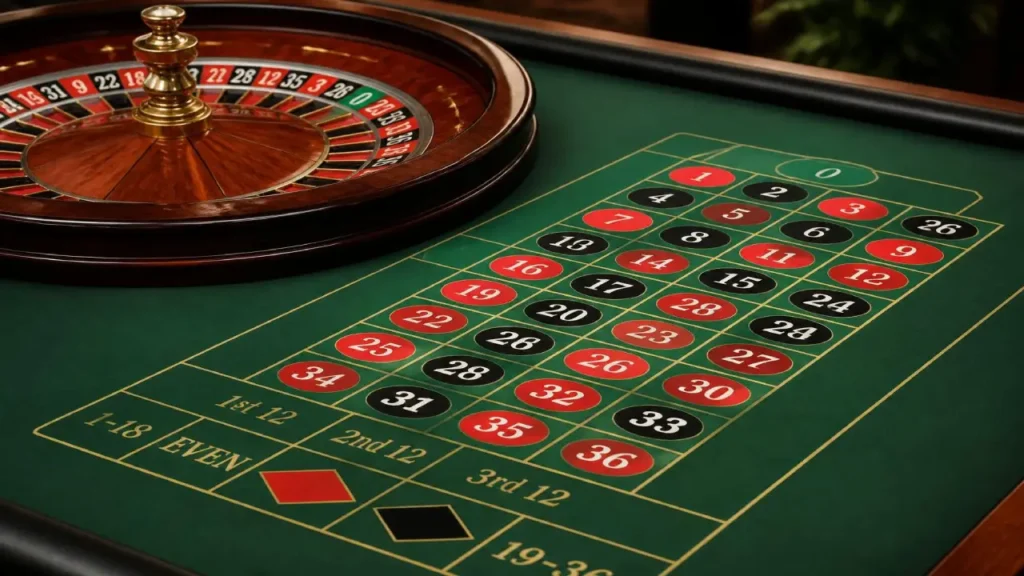
European Roulette with Outside Bets: Simple and Sustainable
European roulette with outside bets is one of the most accessible casino games for beginners because it requires absolutely zero skill or strategy knowledge. You place your chips on a section of the table, the wheel spins, and you either win or lose based on pure chance. There are no decisions to make after placing your bet, no optimal strategies to learn, and no mistakes that can increase the house edge beyond its fixed 2.7%.
Outside bets, specifically red/black, odd/even, and high/low, are the ideal choices for small-budget players because they win approximately 48.6% of the time and pay 1 to 1. This creates a low-volatility experience where your bankroll moves gently in either direction with small, manageable swings. You win almost half the time, which provides consistent positive feedback that keeps the experience enjoyable without the devastating dry spells that high-volatility games can produce.
The critical rule for budget roulette is to always choose European roulette over American roulette. The European wheel has a single zero, producing a 2.7% house edge. The American wheel has both a single zero and a double zero, nearly doubling the house edge to 5.26%. On a ₹1,000 budget, the European version costs you roughly ₹27 per ₹1,000 wagered while the American version costs ₹52.60 for exactly the same experience. There is never a rational reason to play American roulette when European roulette is available.
Some online platforms offer European roulette tables with minimums as low as ₹10 per spin. At that level, a ₹1,000 bankroll gives you 100 spins, which translates to roughly 45 to 60 minutes of playing time depending on your pace. This is an excellent session length for a beginner learning the rhythms of the game and developing their relationship with gambling in a controlled, affordable way.
| Roulette Bet for Beginners | House Edge | Win Frequency | Payout | Budget Suitability |
|---|---|---|---|---|
| Red/Black (European) | 2.7% | ~48.6% | 1 to 1 | Excellent, low volatility, frequent wins |
| Odd/Even (European) | 2.7% | ~48.6% | 1 to 1 | Excellent, identical to red/black |
| High/Low (European) | 2.7% | ~48.6% | 1 to 1 | Excellent, identical to red/black |
| Dozens (European) | 2.7% | ~32.4% | 2 to 1 | Good, moderate volatility, decent payout |
| Columns (European) | 2.7% | ~32.4% | 2 to 1 | Good, same as dozens |
| Red/Black (American) | 5.26% | ~47.4% | 1 to 1 | Poor, nearly double the cost for same experience |
| Straight up number (European) | 2.7% | ~2.7% | 35 to 1 | Not recommended for small budgets |
Baccarat Banker Bet: The Easiest Low-Edge Game
Baccarat is one of the most underappreciated games among beginners, largely because its association with high-roller culture creates the false impression that it requires a large bankroll or sophisticated knowledge. In reality, baccarat is one of the simplest games in the casino, and the banker bet offers one of the lowest house edges available at just 1.06%. You make a single decision, bet on Player, Banker, or Tie, and then the dealer handles everything else according to fixed rules. There is genuinely nothing to learn beyond which bet to place, and the answer to that question is always the same: bet on Banker.
The banker bet wins approximately 45.8% of the time, loses approximately 44.6% of the time, and ties about 9.5% of the time (ties are returned as a push). A 5% commission is deducted from winning banker bets, which is how the casino generates its 1.06% house edge even though the banker bet wins more often than it loses. Despite this commission, the banker bet remains mathematically superior to the player bet (1.24% house edge) and vastly superior to the tie bet (approximately 14.4% house edge).
For small-budget beginners, baccarat offers an excellent combination of low house edge, zero complexity, and fast rounds that make it easy to play within a budget. Online baccarat tables often start at ₹10 to ₹50 minimum, and a ₹1,000 budget provides 20 to 100 hands depending on the minimum. The low volatility of even-money baccarat means your bankroll drifts slowly, giving you extended sessions that feel proportional to your investment.
| Baccarat Bet | House Edge | Win Frequency | Commission | Budget Recommendation |
|---|---|---|---|---|
| Banker | 1.06% | ~45.8% | 5% on wins | Always bet Banker for best odds |
| Player | 1.24% | ~44.6% | None | Acceptable but slightly worse than Banker |
| Tie | ~14.4% | ~9.5% | None | Never bet Tie on a small budget |
| Banker Pair / Player Pair | 10% to 11% | ~7.5% | None | Avoid entirely, extremely expensive |
Low-Volatility High-RTP Slots: Maximum Spins for Your Money
Slots are the most popular game category in every online casino, and while they generally carry higher house edges than table games, the right slot selection can provide excellent entertainment value on a small budget. The key is choosing games that combine high RTP with low to medium volatility, which maximises the number of spins you can enjoy per session and provides the frequent winning feedback that makes the experience enjoyable.
Look for slots with RTPs of 96% or above. This information is available in the game’s help or information section, and checking it takes seconds. A 97% RTP slot costs you ₹30 per ₹1,000 wagered, while a 91% RTP slot costs you ₹90 for the same wagering volume. On a small budget, this difference translates directly into session length: the high-RTP game gives you roughly three times more playing time for the same money.
Low-volatility slots pay out frequently in small amounts, which means your bankroll is constantly being replenished even as it slowly erodes toward the house edge. This creates a satisfying rhythm of wins and losses that keeps the experience engaging without the devastating dry stretches that high-volatility games produce. For a beginner with ₹1,000, a low-volatility slot at ₹2 per spin provides 500 potential spins, which can translate to 30 to 60 minutes of playing time with regular small wins extending the session beyond the pure mathematical expectation.
Set your bet size at 1% to 2% of your session bankroll. For a ₹1,000 budget, this means ₹10 to ₹20 per spin maximum. For a ₹500 budget, ₹5 to ₹10 per spin. This conservative sizing ensures you have enough spins to experience the game’s features, trigger bonus rounds, and give variance a chance to produce positive results. Playing at ₹50 per spin on a ₹500 budget gives you only 10 spins, which is not enough to experience anything meaningful.
| Slot Selection for Small Budgets | What to Look For | What to Avoid |
|---|---|---|
| RTP | 96% or above (check in-game info) | Below 94%, especially below 90% |
| Volatility | Low to medium | High or extreme volatility |
| Minimum bet | ₹1 to ₹5 per spin | Games with ₹50+ minimums on small budgets |
| Bet sizing | 1% to 2% of session bankroll | More than 5% of bankroll per spin |
| Bonus features | Regular trigger frequency | Features that only trigger every 200+ spins |
| Provider | Known studios (NetEnt, Pragmatic Play, Play’n GO) | Unknown providers with unverified RTPs |
| Demo mode | Always try free play first | Never play a new game with real money without testing |
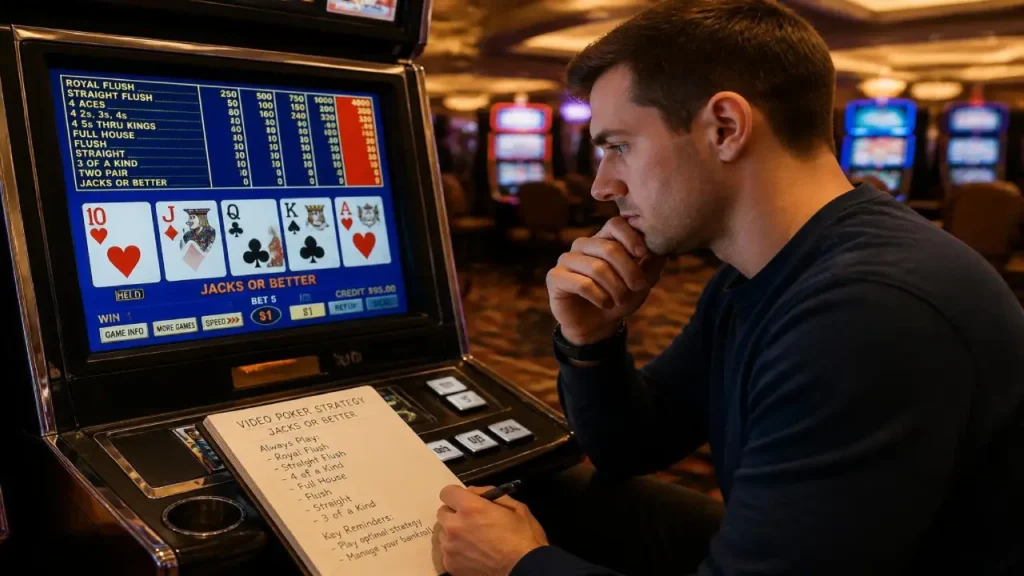
Video Poker: Skill-Based Value for Dedicated Learners
Video poker occupies a unique sweet spot for budget-conscious beginners who are willing to invest a small amount of time learning optimal strategy. Jacks or Better, the most common video poker variant, offers an RTP of 99.54% when played with perfect strategy, making it one of the highest-returning games in the entire casino. This translates to a house edge of just 0.46%, which is comparable to blackjack and significantly better than any slot machine.
The learning curve for video poker is steeper than baccarat or roulette but gentler than poker or craps. The basic strategy involves knowing which cards to hold and which to discard in roughly 30 to 40 common hand situations. Strategy trainers are available for free online, and most players can learn the fundamentals in an hour or two of practice. Once the strategy is learned, the game becomes almost mechanical, allowing you to focus on enjoying the experience rather than agonising over every decision.
Video poker hit frequency is approximately 45%, meaning you receive some form of payout on nearly half of all hands. Most of these payouts are simply getting your bet back (a pair of Jacks or better returns 1 to 1), but the frequency of positive outcomes creates a satisfying rhythm that sustains your bankroll across extended sessions. For a ₹1,000 budget playing at ₹10 per hand, you can expect 100 hands with roughly 45 of them returning something, making the experience feel much more interactive and rewarding than a slot session with a 25% hit rate.
The critical factor in video poker value is the pay table. Not all Jacks or Better games offer the same payouts. The full-pay version, sometimes called 9/6 Jacks or Better because it pays 9 coins for a Full House and 6 coins for a Flush, delivers the 99.54% RTP. Reduced-pay versions like 8/5 or 7/5 cut the RTP significantly, sometimes down to 97% or below. Always check the pay table before playing and choose the most generous version available.
| Video Poker Variant | Full-Pay RTP | House Edge | Complexity | Budget Suitability |
|---|---|---|---|---|
| Jacks or Better (9/6) | 99.54% | 0.46% | Moderate (learnable in 1-2 hours) | Excellent, one of the best values in the casino |
| Deuces Wild (full pay) | 100.76% | -0.76% (player advantage) | Higher (more strategy decisions) | Excellent if you learn optimal strategy |
| Bonus Poker (8/5) | 99.17% | 0.83% | Moderate | Very good, slightly worse than JoB |
| Double Bonus (10/7) | 100.17% | -0.17% (player advantage) | High | Excellent value but requires dedicated study |
| Jacks or Better (8/5) | 97.30% | 2.70% | Moderate | Acceptable but significantly worse than 9/6 |
| Jacks or Better (7/5) | 96.15% | 3.85% | Moderate | Poor, find a better pay table |
Live Dealer Games on a Budget: Is It Possible?
Live dealer games carry higher minimum bets than their digital counterparts, typically starting at ₹50 to ₹200 per round, which makes them less immediately accessible for small-budget players. However, the live dealer experience offers a level of social engagement, transparency, and atmosphere that digital games cannot match, and several strategies make it possible to enjoy live tables even on a limited bankroll.
Many platforms offer promotional live dealer tables with reduced minimums specifically designed to attract new players. These tables may have minimums as low as ₹10 to ₹20 per round, making them accessible on a ₹500 to ₹1,000 budget. The game rules and house edges are identical to standard live tables, so the mathematical value is the same at a fraction of the cost.
Live blackjack and live baccarat are the best choices for budget live dealer play because their low house edges mean your money lasts longer per session. Live roulette is also viable with outside bets, though the slightly slower pace of live dealer roulette means you play fewer rounds per hour compared to digital versions, which actually benefits small-budget players by naturally limiting their exposure.
The key consideration for budget live dealer play is that the social and atmospheric benefits come with a tradeoff in rounds per session. Where digital blackjack might allow you to play 200 hands per hour, live dealer blackjack with multiple players at the table might deliver 50 to 80 hands per hour. For a budget player, this slower pace is actually advantageous because it means your ₹1,000 budget lasts longer in real time, even though you are placing the same number of bets per rupee spent.
The Complete Budget Game Comparison
The table below provides a side-by-side comparison of every game discussed in this guide across the criteria that matter most for small-budget beginners. Use it as a quick reference when deciding what to play during your next session.
| Game | House Edge | Minimum Bet Range | Volatility | Skill Required | Rounds per ₹1,000 | Best For |
|---|---|---|---|---|---|---|
| Blackjack (basic strategy) | 0.5% | ₹10 to ₹50 | Low | Moderate (learn chart) | 20 to 100 | Best mathematical value overall |
| Baccarat (banker) | 1.06% | ₹10 to ₹50 | Low | None | 20 to 100 | Simplest low-edge game |
| European roulette (outside) | 2.7% | ₹10 to ₹50 | Low | None | 20 to 100 | Zero-skill entertainment |
| Video poker (9/6 JoB) | 0.46% | ₹5 to ₹20 | Low-Medium | Moderate (learn strategy) | 50 to 200 | Best value for dedicated learners |
| Low-vol high-RTP slots | 3% to 4% | ₹1 to ₹10 | Low | None | 100 to 1,000 | Maximum spins and session length |
| Live blackjack | 0.5% | ₹50 to ₹200 | Low | Moderate | 5 to 20 | Social experience with best odds |
| Live baccarat | 1.06% | ₹50 to ₹200 | Low | None | 5 to 20 | Premium atmosphere, simple gameplay |
Building Good Habits From Your First Session
The habits you form during your first few gambling sessions tend to persist throughout your entire playing career. Starting with good habits on a small budget creates a foundation of discipline and awareness that serves you well regardless of how your bankroll grows over time. These habits cost nothing to implement but are worth more than any strategy or system in the long run.
Always play in demo mode first. Every reputable online casino offers free play versions of their games, and spending 15 to 20 minutes in demo mode before wagering real money lets you learn the interface, understand the bonus features, and get comfortable with the pace of the game without risking a single rupee. This is especially important for slots and video poker where the mechanics can vary significantly between titles.
Track every session from day one. Record the date, the game you played, your starting bankroll, your ending bankroll, and how long you played. This log creates accountability and awareness that prevents the gradual budget creep that affects many players who start without tracking and slowly increase their spending without realising it. A simple spreadsheet or note on your phone is all you need.
Set a time limit as well as a money limit. Budget management is not just about how much you spend but how long you play. Extended sessions create fatigue that degrades decision-making, particularly in skill-based games like blackjack and video poker. For a beginner, 30 to 60 minutes per session is plenty. You can always come back tomorrow with a fresh budget and a fresh mind.
Celebrate the entertainment, not just the outcomes. A session where you spent ₹500, played for 45 minutes, enjoyed the experience, and walked away having lost ₹200 is a successful session. You paid ₹200 for 45 minutes of entertainment, which is comparable to a movie ticket or a nice meal. Reframing gambling as an entertainment expense with uncertain outcomes rather than a money-making activity is the healthiest mindset a beginner can develop.
| Good Beginner Habit | Why It Matters | When to Start |
|---|---|---|
| Play demo mode before real money | Learn the game without financial risk | Before every new game you try |
| Track every session | Creates awareness and prevents budget creep | From your very first session |
| Set time and money limits | Prevents fatigue-driven and emotion-driven overspending | Before every session begins |
| Start with lowest possible bets | Maximises learning opportunities per rupee | During your first month of play |
| Choose games based on mathematics | Ensures best value regardless of marketing appeal | From your very first game selection |
| Take breaks every 30 minutes | Maintains clear judgment and decision quality | During every session |
| Treat losses as entertainment cost | Builds healthy relationship with gambling | From the moment you start |
Leave a Reply